

Doing things yourself is almost part of the job description when you run a small business.
You answer the emails. Update the website. Send the invoices. Fix the printer. Work out why the spreadsheet suddenly thinks Tuesday is a currency. Then, somewhere amongst all of that, you do the work you actually went into business to do.
Especially in the early days, doing things yourself often makes sense.
Money may be tight. You have time or skills you can use instead. Learning how different parts of the business work can be genuinely valuable. And sometimes doing something yourself really is the quickest and easiest option.
The problem is that I can do this myself can become this is just how I do it, even as your business changes.
Something that made perfect sense when you had five clients may feel very different when you have fifty. A workaround that took ten minutes once a month might now take an hour every week.
But because you can still do it, you do.
The more useful question is whether it still makes sense for you to.
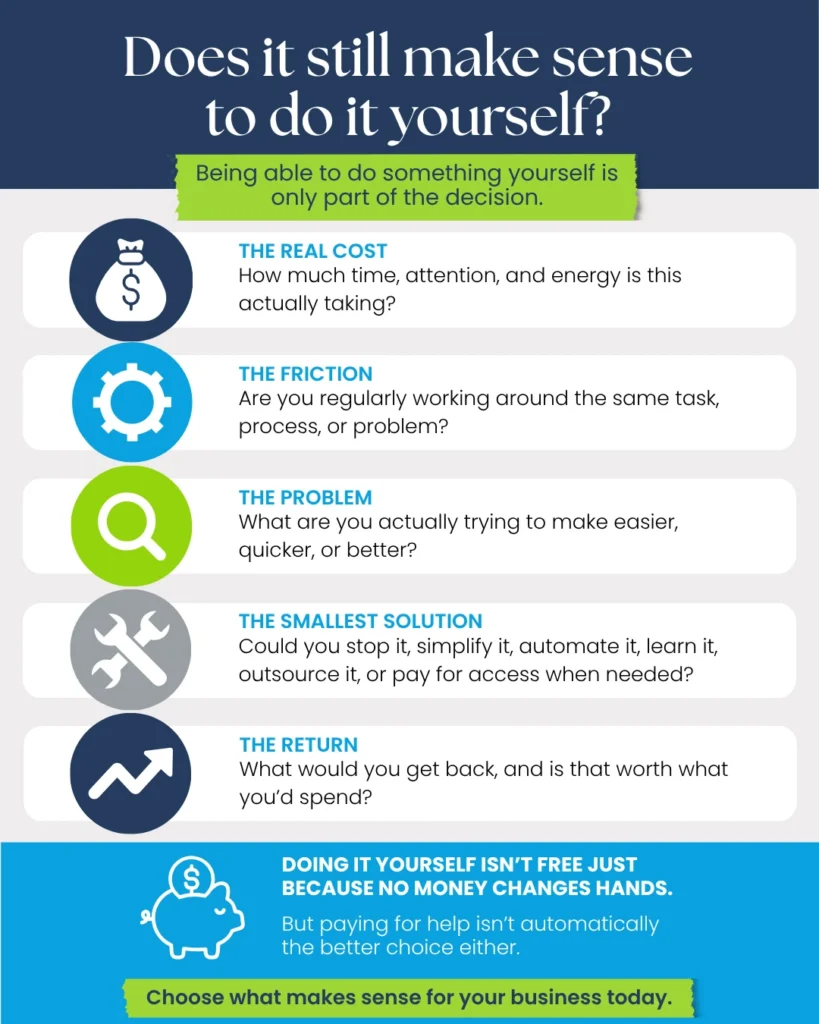
Short on reading time? Skip to the “Doing everything yourself in business” visual summary and work through the decision from there.
Doing it yourself isn’t free just because no money changes hands
It’s easy to compare doing something yourself with paying for a solution and see the maths as fairly simple.
Doing it yourself costs $0.
Paying someone, buying software or using a service costs $X.
Except your time has value too.
So does your attention. So does the time it takes to stop what you’re doing, switch tasks, figure something out, fix the mistake you made while figuring it out, and then remember what you were doing before all of that started.
There is also the work that isn’t happening while you’re busy doing something else, and the personal time that can get swallowed up by work along the way.
That doesn’t mean every hour needs a dollar figure attached to it. Sometimes spending two hours doing something yourself is absolutely the sensible choice.
But if you’re spending those same two hours every week on something you dislike, aren’t particularly good at and could solve another way, the calculation starts looking different.
Doing it yourself may still be the cheapest option.
It just isn’t automatically free.
Pay attention to the workarounds you’ve stopped noticing
Small businesses are exceptionally good at workarounds.
You create them because they solve a problem at the time.
You manually copy information from one system to another.
You use your personal mobile because you already have one.
You receive business mail at home.
You keep a spreadsheet going because it works well enough.
You spend Sunday evening catching up on admin because client work took over the week.
You meet clients at cafés and have developed an impressive mental catalogue of which ones have decent parking, tables big enough for paperwork and coffee grinders that don’t sound like light aircraft taking off.
None of those things is necessarily a problem.
The question is whether you’ve chosen to keep doing them because they still work well, or because you’ve become used to working around them.
Friction in a business is often much less dramatic than people expect.
It’s the task you put off every week.
The interruption you expect.
The extra fifteen minutes you’ve stopped counting.
The thing you find yourself apologising for.
The process that works perfectly well provided nothing unusual happens.
Collect enough of those little accommodations and you can spend a surprising amount of your working week supporting your setup instead of having your setup support you.
Start with the problem, not the solution
Recognising that something isn’t working doesn’t mean you need to go shopping immediately.
Start by getting specific about the problem.
Instead of:
I need an assistant.
Ask:
What am I doing that I actually need help with?
Instead of:
I need an office.
Ask:
What isn’t my current workspace giving me?
Instead of:
I need better software.
Ask:
What am I trying to make quicker, easier or more reliable?
That distinction matters because the obvious solution can be much bigger than the actual problem.
If working from home suits you but you’re uncomfortable publishing your home address, renting an office may be solving ten problems when you only have one.
If you need somewhere private and professional for occasional client meetings, you probably don’t need to maintain a meeting room every day of the year.
If one administrative task is eating hours every week, you may only need help with that task rather than someone to take over every piece of administration.
Work out what you’re trying to change before deciding what you need to change it.
There are more options than “keep doing it myself” or “hand it over”
Once you know what the problem is, the range of possible solutions gets much more useful.
You may be able to stop doing the task altogether. A process can survive for years simply because nobody has checked whether the business still needs it.
You may be able to simplify it. Processes have a habit of collecting extra steps over time, including a few nobody quite remembers the reason for.
You may be able to automate part of it with a relatively inexpensive piece of software.
If it’s a skill you’ll use regularly, learning to do it better may be the most sensible investment.
And yes, sometimes outsourcing is the best answer. Someone with the right expertise may be able to do in an hour what takes you half a day.
There are also plenty of things you don’t need to own or maintain at all.
You may only need access when the need arises.
That could mean hiring equipment rather than buying it, booking specialist support when required, or using flexible business facilities instead of committing to permanent premises.
The aim is to solve the problem in the way that makes the most sense for your business, rather than defaulting to the option that happens to cost the least upfront.
Look for the smallest solution that actually fixes the problem
There’s a tendency to think that as a business grows, every solution should get bigger too.
More people. More systems. More space. More subscriptions. More stuff.
But growth doesn’t automatically require a bigger answer.
If you work happily from home but don’t want your home address appearing across your business correspondence and client-facing materials, a Virtual Office may be enough.
If you need somewhere professional to meet a client a handful of times each month, booking a Meeting Room when you need one may make more sense than paying for permanent space.
The same principle applies elsewhere.
You might need a bookkeeper for a few hours, not another employee.
You might need one piece of software, not an elaborate collection of platforms that requires its own instruction manual.
You might need help with one part of a process rather than handing over the whole thing.
Solve the problem you actually have.
That is usually more useful than trying to make your business look like whatever you think its “next stage” is supposed to look like.
Ask what you get back
Thinking about business spending as an investment can be useful when you stop expecting every investment to produce an obvious line of extra revenue.
Sometimes what you get back is time.
Maybe a service saves you three hours every week.
Maybe specialist help means fewer mistakes and less rework.
Maybe better systems mean fewer interruptions during client work.
Maybe a separate business address gives you more privacy.
Maybe occasional access to professional meeting space makes certain client conversations easier.
Maybe removing one recurring task gives you enough capacity to take on another client.
And sometimes what you get back is simply one less thing occupying space in your head.
Those outcomes do not all show up neatly in a revenue column.
They can still be worth paying for.
The useful question is whether what you get back is worth the cost to you.
And sometimes doing it yourself is still the right answer
There is another side to all of this.
Maybe you enjoy the task.
Maybe you’re good at it and it takes very little time.
Maybe staying closely involved gives you useful information about your clients or your business.
Maybe learning the skill matters to you.
Maybe the alternatives cost far more than the problem is worth.
Or maybe doing it yourself simply works.
In that case, keep doing it.
You do not need to gradually remove yourself from every part of the business until you spend your days gazing serenely at a dashboard while other people and seventeen software subscriptions do everything for you.
The useful distinction is between doing something yourself because it still makes sense and doing it yourself because you’ve always done it yourself.
As the business changes, it’s worth checking which one you’re choosing.
So, does it still make sense to do it yourself?
If something in your business is starting to feel harder than it should, look at it properly before deciding what to do next.
Ask yourself:
Is this still a good use of my time?
What is doing it myself actually costing me?
Is this creating friction somewhere else in the business?
What would change if I solved it?
Is there a smaller or simpler way to solve the problem?
Would what I get back justify what I’d spend?
And perhaps the most revealing question:
If nothing changed, would I still be happy doing this six or twelve months from now?
There isn’t a prize for doing everything yourself. But there isn’t one for outsourcing everything either.
The useful question is whether doing it yourself still makes sense for your business today.
Doing Everything Yourself in Business?
Frequently Asked Questions
Is it normal to do everything yourself when starting a small business?
Yes. Doing things yourself can make good sense when you’re starting out, particularly when money is tight and you have the time or skills to handle things yourself.
It can also help you understand how different parts of your business work. The important thing is to reassess those decisions as your business changes. Something that was efficient when you started may not always stay that way.
How do I know when to stop doing everything myself in business?
Pay attention to tasks that regularly take more time or energy than they seem worth, create bottlenecks, get repeatedly put off, or stop you from doing work that needs your attention.
You don’t necessarily need to stop doing them yourself. But if you’re continually working around the same task or process, it may be worth considering whether there’s now a simpler way to handle it.
When should a small business outsource work?
Outsourcing can make sense when someone else can handle a task more efficiently or effectively than you can, and the benefit justifies the cost.
That doesn’t mean every task outside your core expertise should be outsourced. Sometimes simplifying a process, using software, learning a skill or simply stopping an unnecessary task is a better solution.
How do I decide whether a business expense is worth it?
Start with what you want the expense to change. Then consider what you’ll get back in return.
That might be additional revenue, but it could also be time, capacity, privacy, reliability, fewer interruptions or less mental load. A business expense can be worthwhile when the value it gives you is greater than the cost and it solves a problem you genuinely have.