

Do I need a virtual office?
The answer has surprisingly little to do with what kind of business you run.
You don’t automatically need one because you’re a consultant, freelancer, accountant or graphic designer. And working from home doesn’t suddenly become unprofessional because your business has grown.
The more useful question is whether the way your business is set up still supports the way you actually work.
Maybe you started from home because it was simple, affordable and exactly what you needed. Maybe it still works perfectly well.
But somewhere along the way, things change.
You have more clients. More correspondence. More people looking you up before they contact you. Maybe you’ve started thinking twice before handing out your home address, or you’re getting tired of business mail turning up alongside the electricity bill and the latest online shopping decision you absolutely stand by.
You may not need a physical office to solve any of that.
A virtual office can make sense when the business needs a more established base, even though you’re perfectly happy working the way you already do.
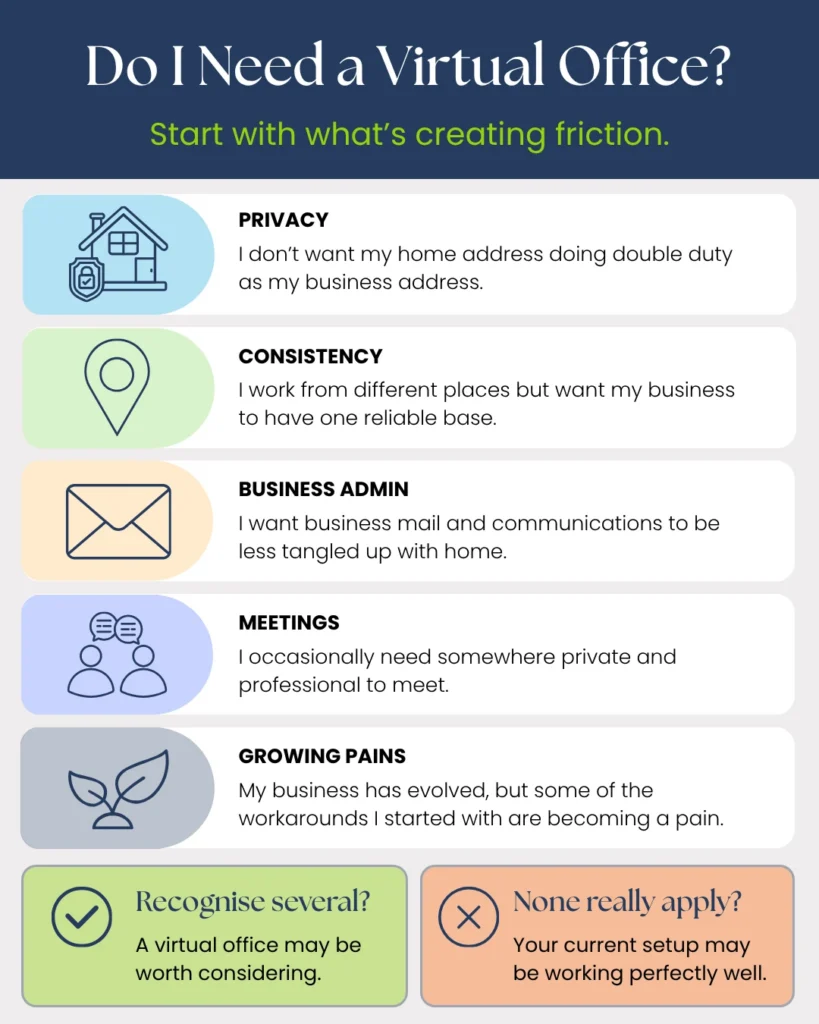
Looking for the quick answer? Skip to our “Do I need a virtual office?” visual summary below.
You’d rather keep your home address private
Using your home address for your business can be completely practical, particularly when you’re starting out.
Until you realise just how many places it appears.
Invoices. Business correspondence. Online listings. Marketing materials. Registration details.
The address you think of as home starts doing an awful lot of work for your business too.
That doesn’t bother everyone. But if you’re starting to hesitate before putting your address on a proposal, giving it to a new client or publishing it somewhere online, that hesitation is probably worth paying attention to.
There’s nothing unprofessional about working from home.
Your clients just don’t necessarily need to know where home is.
For some business owners, that is the entire reason they start looking at a virtual office. They don’t want a traditional office. They just want a business address that isn’t also where they eat dinner.
Your work can happen anywhere, but your business needs a consistent base
One of the advantages of running a flexible business is that your work doesn’t necessarily depend on one location.
You might work from home most days, spend Tuesdays with a client, travel regularly or take your laptop wherever you happen to be most productive.
That works fine until your business information starts becoming as mobile as you are.
A consistent business base means your correspondence has somewhere reliable to go and your address doesn’t need to change every time your working arrangements do.
You can move between home, client sites and wherever else the week takes you without dragging the administrative side of the business along for the ride.
That’s particularly useful when flexibility isn’t a temporary phase you’re trying to grow out of.
It’s how you want to work.
Your original business setup is starting to show its age
Most businesses don’t begin with beautifully designed infrastructure.
They begin with whatever gets the job done.
The spare room becomes the office.
Your personal mobile becomes the business number.
Business mail comes to your house.
Client meetings happen online or at a café.
There’s nothing wrong with any of that.
The friction usually appears when the business grows but the setup underneath it doesn’t.
You hesitate before giving someone your address.
You apologise for the dog losing its mind in the background of a call.
A client asks to meet in person and you immediately start mentally reviewing every café within a 20-minute drive for noise levels, parking, table size and the chances of being seated next to a toddler with a tambourine.
None of these is a catastrophic business problem.
They’re just signs that the setup that worked perfectly well when the business was smaller may be asking you to work around it more than it should.
That’s often the point where a little more infrastructure starts feeling useful rather than excessive.
You need occasional office infrastructure, not an office every day
Maybe you need a professional business address.
Somewhere reliable for mail to go.
A separate business phone number.
A private meeting room a few times a month.
Some help managing calls or correspondence.
If those are the things you actually need, paying for permanent office space can be a fairly expensive way to acquire them.
At Living Workspace, the Virtual Office includes a professional Norwest Central business address, mail receipt and collection, and mail notification. Services such as mail scanning and forwarding, a business landline and limited phone answering can be added separately, while Meeting Room Hire is available when needed and billed separately.
The useful part is being able to pick the pieces that solve an actual problem.
You don’t need to graduate into a lease just because one part of your business has become slightly more complicated.
Some client conversations need more privacy than your usual workspace provides
Plenty of meetings work perfectly well online.
Others are absolutely fine over coffee.
Then there are conversations where the setting matters.
An accountant discussing someone’s finances has different privacy considerations from a designer presenting initial concepts.
A consultant may need to discuss commercially sensitive information. A solicitor may be meeting someone dealing with a difficult personal or business situation.
And occasionally, the conversation is simply too important for you both to be pretending not to hear the coffee grinder.
If those meetings only happen from time to time, access to a private professional meeting room may solve the problem without creating the cost of maintaining one permanently.
This is why the situation matters more than the profession.
An accountant doesn’t automatically need a virtual office. Neither does a consultant, solicitor or designer.
But someone who finds themselves needing facilities they don’t currently have may have a very good reason to consider one.
You want your business to feel more established without giving up the flexibility
Business growth has a habit of making people assume the next step should look more impressive.
More clients. Bigger systems. Permanent premises.
But if working remotely suits you, keeps your overhead manageable and gives you the flexibility you want, there’s no particular virtue in replacing it with an office you don’t need.
Sometimes the grown-up business decision is not adding the biggest possible thing.
It’s fixing the small bits that are starting to get annoying.
A consistent business address, reliable mail handling and access to professional facilities when required can strengthen the business around the way you already work.
If what you genuinely need is somewhere for yourself or your team to sit and work every day, that’s a different question.
You probably need workspace.
A coworking space, dedicated desk or private office may be a better fit.
There are other reasons businesses use virtual offices, too
Not every business considering a virtual office is working from the kitchen table.
An established interstate business may want a consistent Sydney business presence without opening permanent premises there. An overseas company doing business in Australia may have similar reasons for wanting a local base.
Those businesses are solving a slightly different problem, but the principle is the same: they need a business presence in a location without needing permanent premises there every day.
If you intend to use an address for a particular registration, licence, online platform or compliance purpose, check the requirements that apply to your business rather than assuming every virtual office address will be suitable.
When you probably don’t need a virtual office
If your current setup works well, you may not need to change it.
Perhaps you’re comfortable using your existing business address. Privacy isn’t a concern. You rarely receive business mail. You already have somewhere appropriate to meet clients when necessary.
In that case, keep doing what works.
A virtual office should remove friction from the way you run your business.
If you have to invent the friction first, you probably don’t need one.
And if the real problem is that you need somewhere quiet and consistent to work every day, a virtual office is unlikely to solve it.
You need workspace rather than a business address.
So, do I need a virtual office?
By now, you may be asking that question in two slightly different ways.
“Do I need a virtual office?”
And:
“Do I need a virtual office?”
We can’t answer either of those for you. But you can start by looking at what is actually becoming inconvenient.
Are you uncomfortable publishing your home address?
Do you need one consistent business base even though you work from different places?
Are you scrambling for somewhere appropriate every time a client wants to meet privately?
Would reliable mail handling or a separate business number make your business easier to run?
If several of those sound familiar, a virtual office may be worth considering.
There’s no certificate waiting for you when your business becomes “established enough” to need one.
It’s just infrastructure.
And good infrastructure tends to be pretty boring: you notice how useful it is because you stop having to think about the problem it fixed.
Do I need a virtual office? A quick visual summary.
Frequently Asked Questions
What type of business benefits most from a virtual office?
There isn’t one particular type. A virtual office can be useful for home-based businesses, remote businesses, independent professionals and established businesses that need a consistent business presence without permanent office space.
It’s usually more useful to look at what the business actually needs. If you need a separate business address, reliable mail handling or occasional access to professional facilities while keeping the flexibility you already have, a virtual office may be a good fit.
Do I need a virtual office if I work from home?
Not necessarily. If working from home suits you and you’re comfortable using your current address for business, there may be nothing you need to change.
A virtual office becomes useful when you want more separation between home and business, particularly if you’d prefer not to use your home address for clients, correspondence or public-facing business details.
It gives you that separation without changing where you actually work.
Can I use a virtual office if I occasionally need to meet clients?
Yes, absolutely. Meeting room access isn’t included in the virtual office plan, but you can book it separately whenever you need it.
At Living Workspace, Virtual Office clients can book our Meeting Room when they need a private, professional place to meet clients or colleagues. That means you can continue working remotely and only book meeting space when you actually need it.
Is a virtual office the same as having office space?
No. A virtual office gives your business a professional base without providing permanent physical workspace.
If you need somewhere to sit and work regularly, a dedicated desk, coworking arrangement or private office may be more appropriate.
A virtual office is better suited to businesses that already have somewhere to work but need things like a business address, mail handling or occasional access to professional facilities.
Can I use a virtual office address for business registrations or online listings?
It depends on the registration, platform and your individual circumstances.
Different authorities and online platforms have their own eligibility requirements, so it’s important to check the current rules for the particular use you have in mind.
Living Workspace can explain how our Virtual Office service works and what the address can be used for as part of that service, but we can’t guarantee that it will meet the requirements of a particular registration, authority or platform.