
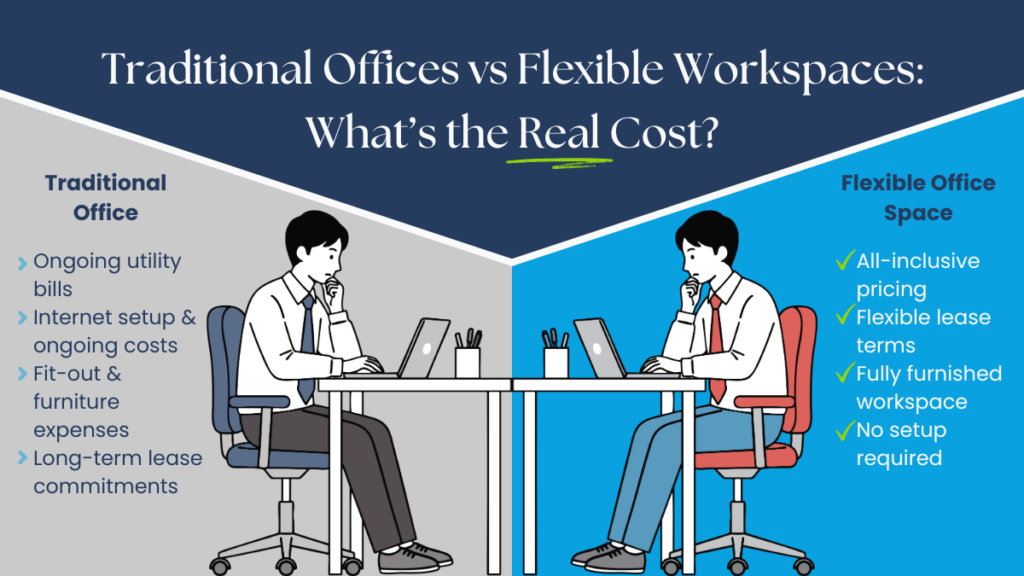
The Hidden Costs of Traditional Office Rentals (And Why More Businesses Are Moving Away From Them)
When you’re choosing where your business will operate from, the decision often comes down to two main options:
A traditional office lease… or something less rigid, like a flexible office space.
At first glance, renting your own office space can seem like the “proper” next step. It feels established. It feels like growth. And it offers a level of control that can be appealing.
But what’s less obvious – especially at the beginning – is how many additional costs sit just beneath the surface.
And over time, those costs can add up quickly.
Why Traditional Office Space Still Appeals
There’s a reason traditional office space has long been the default.
Leasing your own space gives you control over how it looks, how it functions, and how your business presents itself. There’s a sense of ownership that comes with having a dedicated office, even if you don’t technically own the space.
But alongside that control comes responsibility – and often, a range of expenses that aren’t immediately visible when you first sign the lease.
The Hidden Costs of a Traditional Office
These costs aren’t always obvious upfront, but they can have a significant impact on your budget over time.
Fit-out and furniture
Most commercial spaces are essentially a blank canvas. That means furnishing the space – desks, chairs, meeting tables, storage – falls entirely on you.
Depending on the size of the office, this can quickly become a substantial upfront investment.
Utilities
Electricity, water, and air conditioning are typically separate from rent.
These costs can fluctuate throughout the year, especially during Sydney’s hotter months when cooling systems are working harder. That variability can make budgeting more difficult than expected.
Internet and technology setup
Reliable internet is essential, but in many traditional office setups, it’s something you’ll need to organise yourself.
That includes installation, ongoing costs, and potentially additional IT infrastructure – all layered on top of your lease.
Cleaning and maintenance
Ongoing upkeep is another responsibility that often sits with the tenant.
This can mean organising cleaning services, managing waste, and handling general maintenance – all of which add to your operational costs.
Long-term lease commitments
One of the biggest considerations is the lease itself.
Commercial leases in Sydney often range from three to ten years. While that may provide stability, it also limits flexibility.
If your business grows, changes direction, or needs to relocate, exiting a lease early can be complex and costly.
Insurance and compliance
Tenants are usually responsible for various types of insurance, along with compliance requirements such as safety checks and workplace standards.
These are essential – but they do add another layer of cost and administration.
So, What’s the Alternative?
This is where serviced offices offer a different approach.
Instead of managing all of these elements separately, serviced offices bundle them into a single, predictable monthly cost.
You’re not just renting space – you’re stepping into an environment that’s already set up to function as a professional workplace.
What’s Included in a Serviced Office?
While inclusions vary slightly between providers, most serviced offices offer:
- utilities included in your monthly fee
- high-speed internet ready to go
- fully furnished workspaces
- cleaning and maintenance handled for you
- access to meeting rooms and shared facilities
- flexible terms, without long-term lock-ins
For many businesses, this removes a significant amount of complexity.
Why More Businesses Are Choosing Flexible Office Space
The way we work has changed.
Businesses are placing more value on adaptability, simplicity, and financial clarity – especially in uncertain or fast-moving environments.
Here’s why flexible office options are becoming more appealing:
Scalability
As your business grows, your space can grow with you.
And if things shift, you’re not tied into a long-term commitment that no longer fits.
Predictable costs
Having one clear monthly fee makes budgeting far simpler.
There are fewer surprises – and fewer unexpected expenses.
A professional environment
Serviced offices provide a polished, well-maintained setting without requiring you to build it yourself.
That means you can meet clients in a space that reflects your business – without the upfront investment.
Location and accessibility
Being based in a professional hub like Norwest gives you access to transport, amenities, and a wider business community.
It also makes it easier for clients and colleagues to meet with you.
Reduced risk
Shorter, more flexible terms allow your business to adapt as needed.
You’re not locked into decisions that may not suit you six or twelve months down the track.
Making the Right Choice for Your Business
There’s no single “right” answer.
For some businesses, having full control over a space – and the ability to customise it completely – is worth the additional cost and commitment.
But for many modern businesses, flexibility, simplicity, and predictability are becoming far more valuable.
Bringing It All Together
A traditional office might seem straightforward at first – but once you factor in fit-outs, utilities, maintenance, and long-term commitments, the true cost is often much higher than expected.
Serviced offices offer a different approach.
They simplify the process, reduce risk, and provide a professional environment without the need for large upfront investment or long-term lock-in. For many businesses, flexible office space is becoming the future of how they work.
Frequently Asked Questions
Are serviced offices more cost-effective than traditional leases?
In many cases, yes. While the monthly cost may appear higher at first, serviced offices often include expenses that would otherwise be separate – making overall costs more predictable.
Can I scale my space as my business grows?
Yes. Most serviced office providers offer flexible arrangements that allow you to move into larger or smaller spaces as needed.
Do serviced offices still look professional?
Absolutely. They are designed to provide a polished, business-ready environment suitable for client meetings and day-to-day work.
Are serviced offices only for small businesses?
Not at all. Businesses of all sizes use serviced offices, particularly when flexibility and ease of setup are important.
A Simple Place to Start
If you’re looking for a workspace that supports your business without adding unnecessary complexity, a serviced office in Norwest can offer a flexible and professional solution.