

Running a business from home can make you question things you might never think twice about if you had an office.
Does using my home address look unprofessional?
Should I have a separate business number?
Where should I meet clients?
Does my business look established enough?
And perhaps the bigger question underneath all of those:
Does working from home make my business look less professional?
It doesn’t have to.
If you’re wondering how to make your home business look professional, you don’t need to make it look bigger than it is. You don’t need to pretend you have an office you don’t need, a team you don’t have, or an elaborate corporate setup that bears very little resemblance to the way you actually work.
What matters much more is what people experience when they deal with your business.
Professionalism isn’t really about where you work.
It’s about what happens around the work you do.
Short on time? Skip to the “How to make your home business look professional” visual summary below.
Professional doesn’t mean pretending to be bigger
There’s plenty of business advice built around looking bigger or more established.
How to make a one-person business look like a team.
How to make a small business look like a large company.
How to give the impression you have an office when you actually work from home.
But size and professionalism are two different things.
A one-person business can be exceptionally professional.
So can a business run from a spare bedroom, dining table or home office.
Meanwhile, employees, expensive premises and a polished reception area tell you surprisingly little about what it will actually be like to deal with the business behind them.
Your clients are more likely to care whether you know what you’re doing, communicate clearly, do what you say you will and deliver what you promised.
The aim is to present the business you genuinely have in a way that gives people confidence in it.
Look at what people experience
Think about the different ways somebody might encounter your business.
They may find your website.
Send you an email.
Call you.
Look you up online.
Receive a quote or invoice.
See your business address on correspondence.
Book an appointment.
Meet you somewhere.
Ask a question after they’ve already bought from you.
Each of those interactions contributes to their impression of the business.
They don’t need to be immaculate, expensive or impressively corporate.
They need to make sense.
Can people tell what you do?
Is your contact information accurate?
Can they work out how to reach you?
Do your website, emails and documents feel like they belong to the same business?
Do you respond when you say you will?
Does the way people encounter the business reflect the quality of the work behind it?
Professionalism is built through all of those small interactions long before anybody starts wondering whether you have an office.
Separate home and business where it helps
When you start a business from home, using what you already have often makes perfect sense.
Your personal mobile becomes the business phone.
Your home address becomes the business address.
Perhaps you use an existing email account.
The dining table doubles as somewhere to meet people.
Work and home overlap because, at that stage, they naturally do.
Over time, you may decide certain parts would work better with a little separation.
Perhaps you want a dedicated business email address so enquiries don’t get buried between school notices and online shopping receipts.
Maybe a separate business number would make it obvious whether an incoming call is personal or work-related.
You might be perfectly happy working from home but less happy having your home address appear on business correspondence or public-facing information.

Using your home address for business?
Business.gov.au explains the different types of business addresses and what they’re used for, including options for people running a business from home.
Or perhaps meeting clients at cafés has worked for years, but you now occasionally need somewhere quieter and more private.
Each of those is a specific problem with a specific solution.
A separate business number may solve the phone problem.
A Virtual Office can provide a business address without changing where you work.
A Meeting Room can give you professional space when you need it without paying for it every day.
Ask where a little separation would make the business easier to run.
You may only need to change one thing.
Professionalism is often boringly practical
Some of the strongest signs of professionalism are not particularly exciting.
Replying when you said you would.
Turning up on time.
Making it clear how people can contact you.
Keeping your business information up to date.
Sending documents people can understand.
Having a process for enquiries.
Remembering the appointment.
Following up when something goes wrong.
Making sure the voicemail somebody left on Tuesday doesn’t disappear into another dimension.
Most of this is boringly practical.
Nobody is likely to admire your beautifully functioning enquiry process over lunch.
But they will notice when dealing with you feels easy, clear and reliable.
A beautiful logo can help people recognise you.
A professional email address can contribute to your business presence.
A separate business address can provide privacy and consistency.
Those things help, but they can’t do the work of clear communication and reliable service for you.
Professionalism is less about looking impressive and more about giving people confidence that things will happen as expected.
Notice what your business has outgrown
The way you started your business doesn’t need to be the way you run it forever.
Changing something also doesn’t mean the original setup was a mistake.
It may have been exactly right at the time.
A personal mobile might have been perfectly manageable when you received a couple of business calls each week.
Meeting at a local café may have suited the kinds of conversations you were having.
Using your home address may not have bothered you at all.
The invoice template you made yourself one Sunday afternoon might have done sterling service for years.
Then your business changes.
There are more calls.
The conversations are more confidential.
Your address is appearing in more places than you expected.
The documents you send no longer quite represent the business behind them.
Or something that used to feel perfectly normal now makes you hesitate.
That hesitation is worth paying attention to.
You don’t need to replace everything simply because the business has grown.
It is worth checking whether the things around your work still suit the work you’re doing now.
The same can be true of the things you do yourself. If you’ve picked up tasks and workarounds along the way, we’ve looked at how to decide whether doing everything yourself in business still makes sense.
Change what is creating friction, not everything
Once you notice something that no longer works particularly well, it can be tempting to upgrade the whole business at once.
New systems.
New software.
New branding.
New phone.
New office.
New everything.
Before you launch a full-scale Business Professionalism Renovation, get specific about the problem.
Are you worried about privacy?
Do clients struggle to contact you?
Are business calls interrupting your personal time?
Do you need somewhere appropriate for occasional meetings?
Is information inconsistent across different places online?
Does an old process create unnecessary work?
Does something public-facing simply no longer represent the business very well?
Solve that problem first.
The answer may cost nothing. You might update some information, change a process or create clearer boundaries around when you’re available.
Perhaps a small piece of software would help.
Perhaps one business service could take care of a particular need.
Or you may look at the problem properly and decide the current setup is still doing its job.
A professional home business doesn’t need to collect every piece of infrastructure associated with a traditional office.
It only needs the things that make sense for the way you actually work.
So, does your home business look professional?
Instead of comparing your business with an imaginary version of what a “proper business” is supposed to look like, look at the experience you’re creating.
Ask yourself:
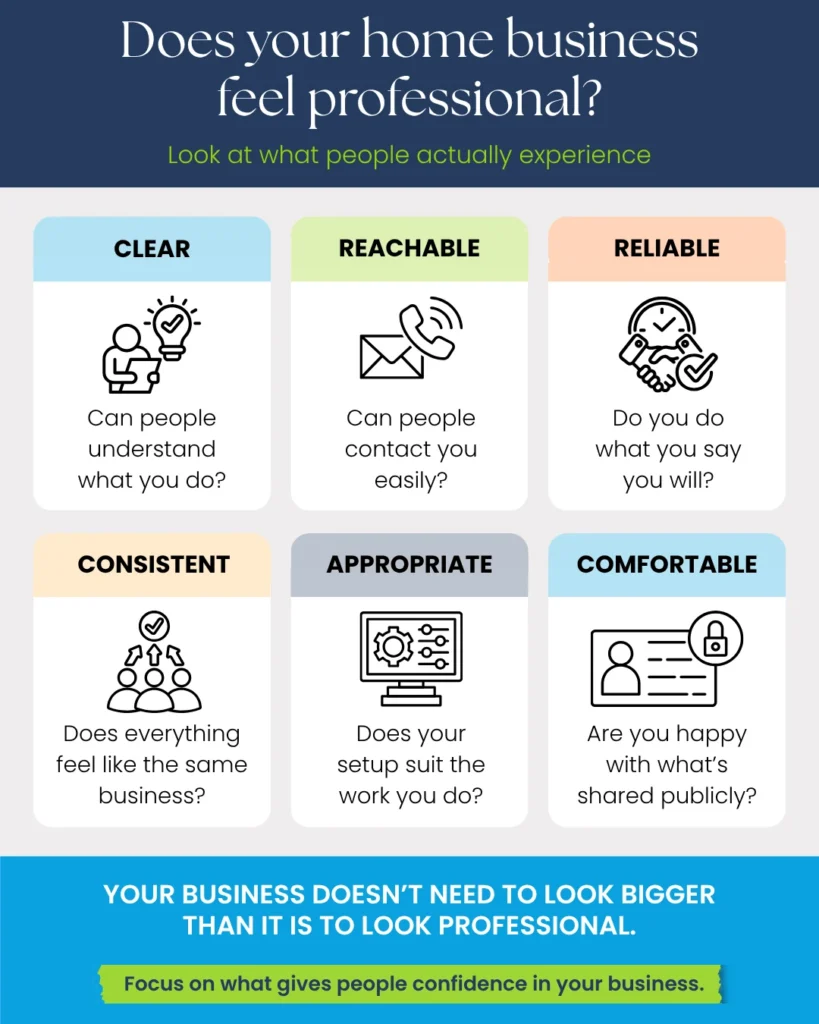
Can someone easily understand what my business does?
Is it easy to contact me in the way I want to be contacted?
Do I communicate reliably and consistently?
Does my public business information reflect the business as it is now?
Am I comfortable with the personal information I’m making public?
Do I have an appropriate way to meet clients when I need one?
Are there parts of my original setup that I’ve simply outgrown?
You may find a few things worth changing.
You may find the setup you already have works perfectly well.
Either answer is useful.
If you’re doing great work from home, the goal isn’t to hide the home part.
It’s to make sure nothing around it is getting in the way of the business part.
Not sure what your business presence is saying about your business?
Our free Business Presence Snapshot takes you through a few quick questions about how your business currently shows up, then gives you a starting point for anything that might be worth a closer look.
Take the business presence snapshot
How to Make Your Home Business Look Professional Visual Summary
Frequently Asked Questions
Does working from home make my business look unprofessional?
No. Where you work doesn’t determine how professional your business is.
Clients are more likely to notice whether your business is easy to understand and contact, whether you communicate reliably, and whether their experience matches the quality of the work you provide.
Working from home can simply mean thinking deliberately about where you want your home and business lives to overlap, and where a little separation would be useful.
Do I need a business address if I work from home?
Not necessarily. Whether you need a separate business address depends on how your business operates and how comfortable you are using your home address for business purposes.
Some home-based business owners use their residential address without any problem. Others prefer a separate business address for privacy, consistency or because they don’t want their home address appearing across business correspondence and public-facing materials.
If that separation would be useful, a Virtual Office may be one option.
Do I need an office to meet clients professionally?
No. If you only meet clients occasionally, maintaining permanent office space may be unnecessary.
Depending on the kind of meeting, you might meet at the client’s premises, online, at an appropriate public location, or book a private Meeting Room when you need one.
The useful question is what kind of environment the conversation actually requires.
What makes a small business look professional?
There isn’t one particular thing.
Clear communication, accurate business information, reliable processes, appropriate contact details and consistency across the places clients encounter your business can all contribute.
Rather than trying to make your business appear bigger or more corporate, focus on whether dealing with it feels clear, reliable and appropriate for the work you do.