

You’ve found a serviced office that could suit your business.
Then you look at the monthly price.
Then you look at a commercial property listing and see a much larger office advertised at what appears to be a much lower rate.
And you think:
Why does the serviced office cost so much?
It’s a reasonable question.
On floor space alone, a serviced office can look expensive compared with leasing your own premises.
But those two advertised prices may be describing very different things.
One may be the price of a workspace that is already furnished, connected and ready to use, with some facilities and running costs included.
The other may be the rent for the premises, with other costs involved in establishing and operating the office sitting outside that advertised figure.
So before deciding which one costs more, it helps to compare the full workspace rather than the number at the top of the listing.
Otherwise, you may be comparing apples with oranges.
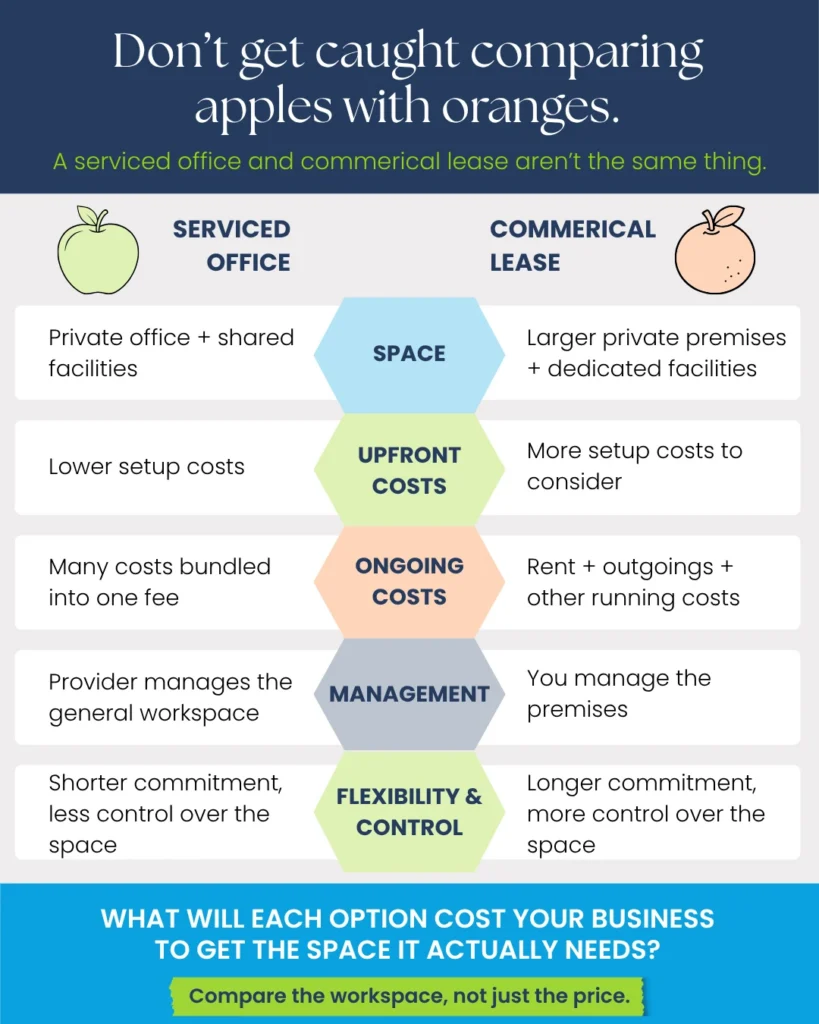
Short on time? Skip to our “Why does a serviced office cost so much?” visual summary below.
Why can a serviced office look expensive?
Start with the obvious difference: space.
If you compare the floor area inside a private serviced office with the floor area of a commercial tenancy, the serviced office may not look particularly competitive.
But the private office may only be part of the space you use.
Depending on the provider, you may also have access to shared areas such as a kitchen, meeting room, reception or waiting area and other common facilities without having to lease all of that floor space yourself.
Some of the costs involved in running the workspace may also be included in the monthly price.
That changes what you’re comparing.
A larger commercial tenancy may give you more exclusive floor space.
A serviced office may give you less private space but access to other facilities and services around it.
The useful question is how much workspace your business needs and what it will cost to make that workspace usable.
What does the serviced office price include?
There isn’t one standard serviced office package.
Before comparing the monthly price with another office option, find out exactly what is included.
Depending on the provider, that might include things such as:
- furniture
- internet
- electricity and other utilities
- cleaning
- use of shared kitchen or common areas
- meeting room access
- parking
- reception or mail services
- maintenance of the workspace
Some providers bundle many of these into the monthly fee. Others charge separately for particular services or usage.
That distinction matters.
A higher headline price may include costs you would pay separately elsewhere. A lower one can become less attractive if the services you need regularly sit outside the monthly fee.
Compare the package you’re likely to use, not simply the advertised number.
What sits outside the advertised rent on a commercial office?
Commercial leasing works differently because you are taking on the premises yourself.
Exactly what you will be responsible for depends on the property and the terms of the lease, so there is no universal list to add to every advertised rent.
But rent may only be one part of the cost.
Depending on the arrangement, you may need to account for fit-out, outgoings, utilities, insurance, cleaning, maintenance and other expenses associated with occupying the premises.
There may also be security requirements such as a bond or bank guarantee.
Lease incentives can change the picture too. A rent-free period, rent reduction or contribution towards fit-out can make a significant difference to the overall cost.
This is why an attractive rent figure can’t always be assessed in isolation.
If you are considering leasing commercial premises in NSW, the NSW Small Business Commissioner has guidance on understanding leasing costs, including fit-out, outgoings, insurance, security and end-of-lease requirements.
There’s also the cost of getting an office ready to use
Signing the lease doesn’t necessarily mean everyone can turn up with their laptops on Monday morning.
Someone may need to organise desks and chairs.
Internet needs to be connected.
Utilities need to be arranged where they aren’t already provided.
Equipment has to be moved or purchased.
Access needs to be sorted out.
Depending on the premises, there may be fit-out work to coordinate before anybody can work there at all.
For some businesses, that effort is entirely worthwhile.
We’ve seen businesses move into their own offices because they genuinely needed the additional space and control. It was the right move for them.
But getting from “we have signed the lease” to “this is a functioning workplace” can involve considerably more work and expense than the advertised rent suggests.
With a serviced office, much of that setup has already happened.
You bring the things specific to your business and get on with using the space.
Someone also has to run the office
The work doesn’t stop once everyone has moved in.
Things break.
Supplies run out.
Furniture needs replacing.
A tradesperson needs access.
The internet develops an exciting new personality at 9:07 on Monday morning.
Someone has to deal with it.
In a small business, that person may be the owner.
For a remote team whose operational support is based elsewhere, office management can fall to local employees whose actual jobs have nothing to do with organising trades, furniture, utilities or facilities.
That time belongs in the comparison too.
A serviced office moves much of the general management of the workspace to the provider.
For some organisations, that convenience has real value. Others already have people and systems in place to manage premises efficiently.
The question is how much responsibility your business wants to take on itself.
Flexibility has a value, but so does certainty
The length and terms of your commitment belong in the comparison too.
A business with a stable team, clear space requirements and plans to remain in one location for years may value the certainty of a longer lease.
A business with less predictable space requirements may place more value on flexibility.
Neither position is inherently better.
The useful question is how well the commitment matches what you expect the business to need.
A workspace that is cheaper over five years is only useful if you genuinely want to be there for five years.
Likewise, flexibility is only valuable if your business is likely to use it.
When can your own office be better value?
For some businesses, leasing their own premises will be the better financial and operational choice.
That may be the case if you have a larger or stable team, need substantial space, want control over how the premises are configured and expect to remain there for a long time.
You may be able to spread setup costs over years of use.
You can decide how the space works.
And if you already have the people and systems to manage premises, some of the convenience built into a serviced office may have less value to you.
Sometimes outgrowing flexible office space simply means the business now needs something the serviced arrangement can no longer provide.
That is a perfectly reasonable next step.
When can a serviced office be better value?
A serviced office can make more sense when you need less private space than you would have to lease independently but still want access to facilities such as a kitchen, meeting room or reception area.
It may also suit a business that wants to avoid the upfront work of establishing its own premises, prefers more predictable workspace costs or doesn’t want its team managing the day-to-day practicalities of an office.
That isn’t limited to startups and one-person businesses.
A serviced office can also work well for an established organisation with a small local team, particularly when the company’s operational support is based somewhere else.
In that situation, the comparison may be:
serviced office versus establishing and managing an entire local workplace for a handful of employees.
That is a very different calculation from comparing two monthly rent figures.
How do you compare serviced office costs properly?
This is where we can finally put the apples back with the apples.
Start with the workspace your business needs, then price each option on that basis.
Look at:
The space you need.
How much private space do you require? What other facilities will you need access to?
Upfront costs.
What will you need to spend before the office is ready to use?
Ongoing costs.
What is included in the advertised price, and what will you pay separately?
The work involved.
Who will organise, maintain and manage the workspace?
The commitment.
How long are you committing for, and how well does that match what you expect the business to need?
What happens if your needs change.
What are your options if the team grows, shrinks or needs a different kind of space?
Once you compare those things, you have a much better basis for deciding which option offers better value for your business.
So, why does a serviced office cost so much?
Sometimes it genuinely costs more.
You are paying for convenience, shared facilities, an established workspace and some of the work involved in running it.
In other situations, a commercial lease may offer better value because the business needs more space, more control and expects to stay for long enough to justify the setup.
The useful comparison isn’t the price of the room.
It’s what it will cost your business to get the workspace it actually needs.
If a serviced office sounds like the kind of workspace your business needs, you can take a look at our Serviced Offices in Norwest to see what’s included and how they work.
Why does a serviced office cost so much visual summary
Frequently Asked Questions
How much does a serviced office cost?
Serviced office prices vary depending on the location, office size, number of people it accommodates, what is included and how the provider structures its fees.
Rather than comparing the serviced office price with commercial rent alone, compare the total cost of creating the workspace you need.
For a commercial lease, that might mean considering:
rent + outgoings + setup and furniture + utilities + cleaning + other ongoing costs + the time involved in managing the premises
Then compare that with:
serviced office fee + any services or usage charged separately
The exact costs will be different for every business, but comparing the same requirements on both sides gives you a much more useful figure than comparing the two advertised prices.
Are serviced offices more expensive than traditional offices?
They can be, particularly if you compare the amount of private floor space you receive for the price.
But that doesn’t necessarily tell you which option will cost your business more overall. A serviced office may include furniture, internet, utilities, shared facilities and other services that you would need to arrange or pay for separately with your own premises.
The useful comparison is the total cost of getting and running the workspace your business actually needs.
What is usually included in the cost of a serviced office?
It varies between providers.
Depending on the serviced office, the price may include furniture, internet, utilities, cleaning, shared facilities, parking, meeting room use, reception or mail services and maintenance.
Some providers include most of these in one fee, while others charge separately for particular services or usage. Check exactly what is included before comparing prices.
Are serviced offices worth the cost?
They can be when you value having a workspace that is already established and managed for you.
That may be particularly useful if you only need a small private office, want access to shared facilities, don’t want to establish and manage your own premises, or have a local team without local operational support.
For a business that needs substantial space, wants greater control and expects to remain there for a long time, leasing its own premises may offer better value.
What should I compare when choosing between a serviced office and a commercial lease?
Look beyond the advertised monthly price or rent.
Compare the space and facilities you need, upfront setup costs, ongoing expenses, what is included, the work involved in managing the premises, the length of the commitment and what happens if your space requirements change.
The cheapest advertised option isn’t necessarily the lowest-cost option for your business.