
Wondering where to meet clients without an office?
You don’t need a permanent office to run a professional business.
You may not need an office at all.
Perhaps you work from home. Maybe you spend most of your time at client sites. You might work remotely, travel between locations, or simply run a business that doesn’t need permanent premises.
Then you need to meet someone face to face.
Suddenly, there’s a very practical question to answer:
Where should you meet them?
Not having an office still leaves you with plenty of options.
The useful question is what this particular meeting needs.
A quick catch-up over coffee is very different from a two-hour meeting involving documents, several people and a screen.
So before you start looking for somewhere to meet, start with the meeting itself.
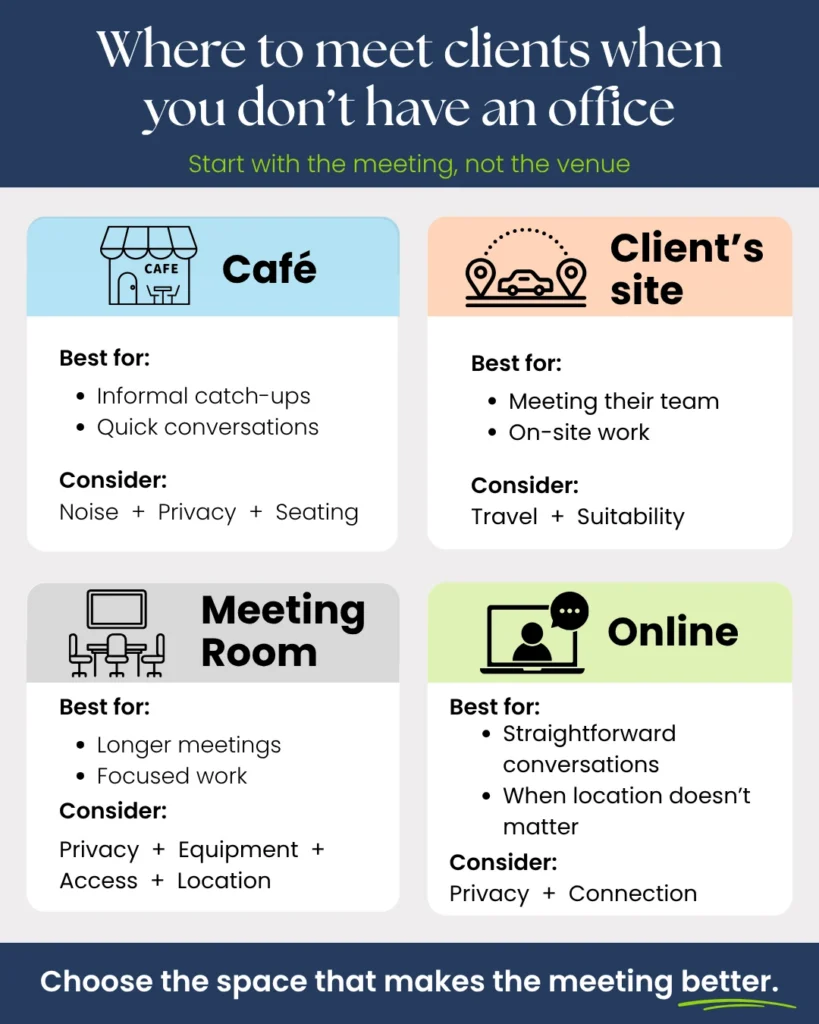
Short on time? Skip to our “where to meet clients without an office” visual summary below.
Start with the meeting, not the venue
Think about what will actually be happening.
How many people will be there?
How long do you expect the meeting to take?
Will you need to discuss anything sensitive?
Do you need reliable Wi-Fi, power, a screen or other equipment?
Will you be working through documents together?
Does anyone attending have accessibility requirements?
Where is everyone travelling from?
And how formal does the meeting need to be?
Professional and formal are not the same thing.
A café can be entirely appropriate for one conversation and completely unsuitable for another.
Choose the setting based on what the meeting needs to run well.
A café can be perfectly fine
There’s nothing inherently unprofessional about meeting a client over coffee.
For an informal catch-up, an introductory conversation or a quick discussion with somebody you already know, a café may be exactly what you need.
It’s easy. There are plenty of them. Nobody has to make a booking weeks in advance.
And there’s coffee.
But cafés come with things you can’t control.
They can be noisy or crowded. You might struggle to find a suitable table. Conversations can be overheard. Spreading documents across a tiny table between two flat whites can become an exercise in spatial engineering.
For a private conversation, or one that will be lengthy or require concentration, those limitations matter more.
At that point, the meeting may simply need a different kind of space.
Sometimes the client’s workplace makes more sense
If your client has suitable premises, meeting there can be the simplest option.
It saves them travelling and may be especially useful if you need to meet several members of their team, see something on site, or work with information and equipment they already have there.
For consultants and other businesses that regularly work at client locations, this may already be completely normal.
The main trade-off is that the travel is always yours.
And, of course, your client may not have an appropriate place to meet either.
If their workplace suits the meeting and everyone involved, use it.
Some meetings don’t need a room at all
Sometimes the best place to meet is nowhere.
Or, more accurately, wherever everyone happens to be when they open Teams or Zoom.
If people are in different locations and there’s no particular benefit to being physically together, a video call may be the easiest option.
It removes travel time, makes scheduling easier and may be all you need for a straightforward conversation.
Face-to-face meetings become more useful when being in the same room improves the work.
Perhaps you’re going through physical documents or materials together.
Maybe several people need to collaborate.
It might be an important first meeting where being together makes the conversation easier.
The question is simple:
Does being in the same room make this meeting better?
If not, save everyone the trip.
When hiring a meeting room starts to make sense
A hired meeting room becomes useful when you need something your usual options can’t reliably provide.
Perhaps you need a private room away from other customers.
You might need guaranteed seating for several people, a proper table to work around, reliable internet or presentation facilities.
Maybe the meeting will run for a few hours and you simply want somewhere everyone can settle in and concentrate.
There’s also value in predictability.
You know where you’re going.
You know there will be somewhere to sit.
You know the space is reserved for your meeting.
You don’t have to arrive 20 minutes early and conduct reconnaissance for the least-wobbly table near a power point.
Hiring a meeting room is often less about appearance and more about removing uncertainty.
You can turn up and get on with the meeting.
What should you check before booking a meeting room?
Not all meeting rooms work the same way, so it’s worth checking the practical details before you book.
Start with the basics: how many people can the room comfortably accommodate, and what does the booking include?
Then think about what your meeting needs.
Is Wi-Fi available?
Is there a screen or presentation equipment if you need it?
Can you access power easily?
How private is the room, and is that suitable for the conversation you’ll be having?
What are the minimum booking periods and cancellation terms?
It’s also worth thinking beyond the room itself.
Where will attendees park, or how will they get there?
Is the location easy to find?
What happens when your guests arrive?
Are there accessibility requirements you need to check?
Can you bring food or drinks?
If your meeting is outside normal business hours, how does access work?
A beautiful room isn’t particularly useful if half your meeting is spent trying to get everybody into it.
Check the details that will make the day run smoothly.
You don’t need an office just in case somebody wants to meet
If working from home suits your business, an occasional client meeting doesn’t need to dictate your entire business setup.
The same applies if you work remotely, spend most of your time on the road or usually visit clients at their premises.
Use a café when a café works.
Meet at your client’s workplace when that makes sense.
Use a video call when nobody needs to travel.
Hire a meeting room when the meeting needs one.
Permanent office space may be the right answer for some businesses.
For others, two hours in a meeting room next Thursday is enough.
So, where should you meet your client?
Match the space to what you’re actually doing.
A quick, informal catch-up may be perfectly suited to a café.
If your client has an appropriate workplace and it makes sense to go to them, do that.
If meeting face to face adds nothing useful, save everyone the trip and meet online.
And when you need a predictable space where you can sit down together and get some work done, hiring a meeting room can fill that gap without giving you an office you don’t otherwise need.
You don’t have to choose the most impressive option.
Choose the one that makes the meeting work better.
Need a meeting room in Norwest?
If a hired meeting room turns out to be the right fit for your next meeting, Living Workspace has a private meeting room in Norwest available by the hour, half day, or full day.
You can see our Norwest meeting room and booking details here.
Where to meet clients without an office visual summary
Frequently Asked Questions
Can I hire a meeting room if I don’t have an office?
Yes. Meeting rooms can usually be hired independently, so you don’t need to lease an office or use the space regularly. They can be useful when you occasionally need somewhere to meet clients, hold a longer discussion or work together in person.
Is it unprofessional to meet a client in a café?
Not necessarily. A café can be perfectly appropriate for an informal catch-up or short conversation. The important thing is whether it suits the meeting. Noise, privacy, available seating and the amount of time you need may make another option more suitable.
What should I look for when hiring a meeting room?
Start with what your meeting needs. Check the room capacity, Wi-Fi, available equipment, access and booking conditions, as well as practical details such as parking, accessibility and what happens when your guests arrive.