

Once you’ve decided a Virtual Office might suit your business, the next question seems fairly straightforward.
Which one?
At first, comparing Virtual Offices can look a lot like comparing addresses and prices.
Where is it?
How much does it cost?
Done.
Except the address is only part of what you’re choosing.
You’re also choosing what happens when mail arrives there. What support is available when you need it. What the advertised price includes. Whether there are other facilities or services you can access if your needs change.
And whether the service can do the job you’re choosing it for in the first place. So before comparing street names and monthly fees, here are some useful questions to ask.
Short on time? Skip to our “What to Look for in a Virtual Office” visual summary below.
Can you use the address for what you need it for?
Start with the reason you want a business address.
Do you want to use it on your website and marketing materials?
For business correspondence?
As your registered office address?
For online business listings?
For a particular registration, licence or platform?
Those uses aren’t necessarily interchangeable. Different organisations and platforms have their own requirements, so an address being suitable for one purpose doesn’t automatically make it suitable for another.
Before signing up, tell the provider how you intend to use the address and ask whether it is generally suitable for that purpose.
If you’re relying on it for a particular registration, licence or online platform, check the current requirements with that organisation directly too.
A great address isn’t particularly useful if it can’t do the job you need it to do.
If you run your business from home, the NSW Small Business Commissioner also has useful guidance on ways to give customers and suppliers contact details without necessarily using your home address.
What happens when your mail arrives?
If your new business address receives mail, somebody has to do something with it.
That sounds obvious, but it’s worth finding out exactly what that something is.
How will you know when mail arrives?
Where and how is it stored?
When can you collect it?
Can somebody else collect it on your behalf?
Can your mail be opened and scanned if you want it to be?
Can it be forwarded to you?
Are those services included, or do they cost extra?
You may not need every option. If you live or work nearby, collecting your own mail might be perfectly convenient.
You just want to know how the process works before the first envelope turns up.
What does the advertised price include?
Two Virtual Offices can have similar monthly prices while providing quite different services.
One might bundle several services into the monthly fee. Another might offer a simpler base service and let you add extras separately.
The better model is whichever matches what you’re likely to use.
Look beyond the headline fee and compare the things that matter to you. Depending on the provider, that could include mail handling, scanning or forwarding, phone services, meeting-room or workspace access, setup fees and other additional charges.
And don’t let a long inclusions list do all the persuading.
If one package includes five services you’ll rarely touch while another gives you exactly the two you need, “more included” may not mean better value.
Compare the cost of the service you’ll actually use.
Is there somewhere real behind the address?
A Virtual Office may be virtual from your perspective, but the address itself is very much a physical place.
It’s worth understanding what happens there.
Is there a team on site?
What happens if you have a question about your mail?
What if a courier arrives with something unusual?
Can you visit the location yourself?
What happens if a client turns up unexpectedly?
You may rarely need to speak to anybody there. That’s fine.
But if the address is going to become part of your business presence, it helps to know what’s happening at that address when you’re not there.
Does the location make sense for your business?
A recognisable postcode might look good on paper, but location has a more practical job to do.
Think about how you’ll use it.
If most of your clients are in a particular area, does the address support that local presence?
If you plan to collect mail, is getting there practical?
If meeting facilities are available, will the location work for you and your clients?
Does the address fit the way you describe and market your business?
For a business working with clients around the Hills District, for example, a Norwest address may provide a useful local base even if most of the work happens somewhere else.
Another business may care far more about easy mail collection, proximity to clients or access to meeting facilities.
Choose the location for the job you need it to do, not just for how impressive it looks in the address line.
What else can you access if you need it?
You may only need a business address today.
Later, you might occasionally need somewhere private to meet a client.
There may be days when working from home isn’t practical and access to workspace would be handy.
You might eventually want mail forwarding, a separate business number or some help with calls.
You don’t need to pay for all of that in anticipation of a future problem.
But it can be useful to know whether those options exist, how you access them and what they cost.
Having the option to add something when you need it can be a better fit than paying for it every month when you barely use it.
You’re not trying to predict every future version of the business.
You’re checking whether you have somewhere to go if the need arises.
What are you committing to?
The monthly price tells you what the service costs.
The terms tell you what you’re agreeing to.
Before signing up, check:
How often are you billed?
Is there a minimum term?
How much notice do you need to give if you want to leave?
Are there setup or cancellation costs?
What happens to mail received after your service ends?
Are there separate terms for any additional services you use?
The shortest commitment won’t suit every business, and neither will the longest.
What matters is understanding the arrangement before you find yourself trying to change or cancel it.
So, how do you choose a Virtual Office?
Start by writing down what you need the service to do.
Then compare the same things across each provider:
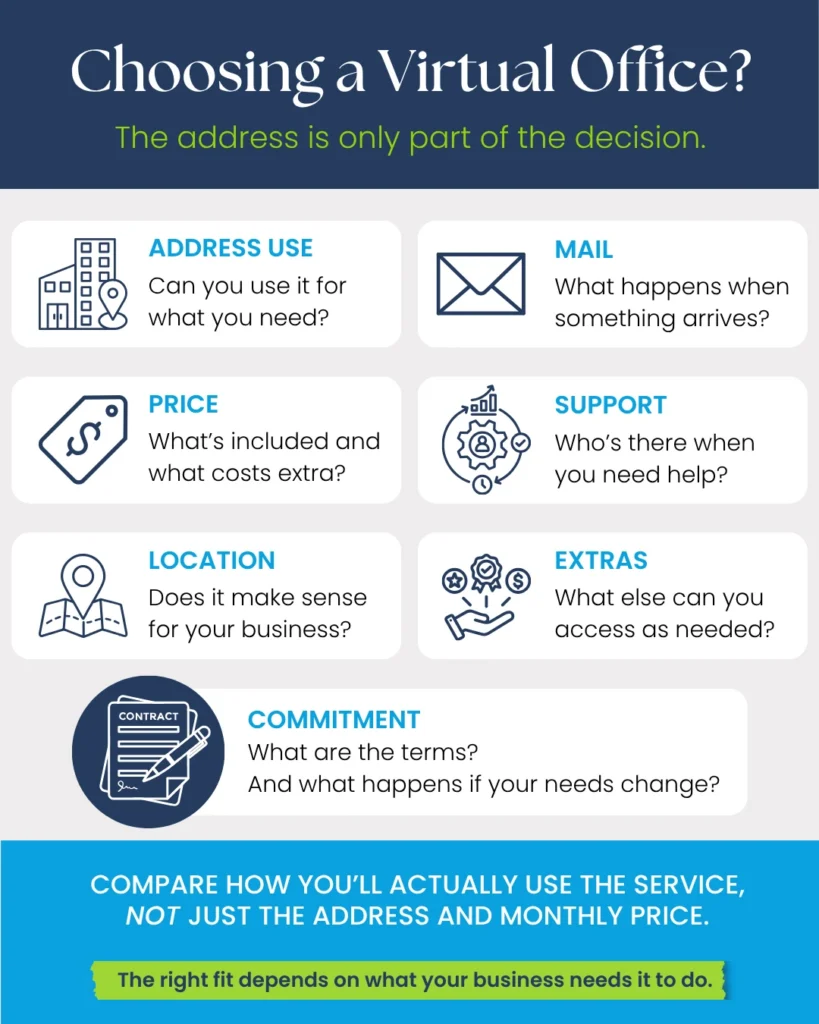
- whether the address is suitable for how you intend to use it
- how your mail will be handled
- what’s included and what costs extra
- what support exists behind the service
- whether the location makes sense
- what other facilities or services you can access
- what you’re committing to
You may discover that the simplest service is all you need.
Or you may decide that a particular location, extra service or level of support is worth paying more for.
Either way, you’re comparing Virtual Offices based on how you’ll actually use them rather than trying to judge the whole service from an address and a monthly price.
Because when you choose a Virtual Office, the address matters. It’s just not the only thing you’re choosing.
Not sure whether a Living Workspace Virtual Office is right for your business? We’re happy to have a chat and help you decide. Contact us, or visit our Virtual Office page to see how the service works and what’s included.
What to look for in a Virtual Office: A Quick Visual Summary
Frequently Asked Questions
What is a Virtual Office?
A Virtual Office gives your business a professional business address without requiring you to rent permanent office space. Services vary between providers, so it’s worth checking exactly what is included and how the address can be used.
Do I need a Virtual Office?
Not necessarily. If your current arrangements work well for you, there may be nothing you need to change. A Virtual Office can be useful when you want a separate business address, a consistent base for your business or access to additional business services without maintaining a permanent office.
Not sure? Read “Do I need a Virtual Office? When your business needs a base, not office space.“
What’s the difference between a Virtual Office and a workspace?
A Virtual Office gives your business an address and associated services without providing a permanent place to work. Workspace gives you somewhere physical to work.
Depending on the provider, meeting rooms or workspace may be available separately, but they aren’t necessarily part of the Virtual Office service itself.
Can I use a Virtual Office as my registered business address?
Generally, a Virtual Office address may be suitable for business registration purposes, but the requirements depend on what you are registering and with which organisation. Check with the provider about the intended use of the address and confirm the current requirements with the relevant organisation before relying on it for a particular registration.