
When you picture a small business workspace, it’s easy to start with what you think an office is supposed to have.
A dedicated room. A proper desk. Office furniture. Meeting space. Storage. Perhaps eventually premises of your own.
But before you start buying furniture, signing up for software or looking at office listings, there’s a more useful question to ask:
What does your business need its workspace to do?
You may need somewhere quiet to work every day.
You may be perfectly happy working from home but need somewhere to meet clients occasionally.
You might need a business address that is separate from your home.
Perhaps you have employees who need somewhere to work together.
Or you may need several of those things.
They’re different requirements, and one office doesn’t have to solve all of them.
Working that out first can help you create a workspace that fits the way you do business without paying for space, services or equipment you won’t use.
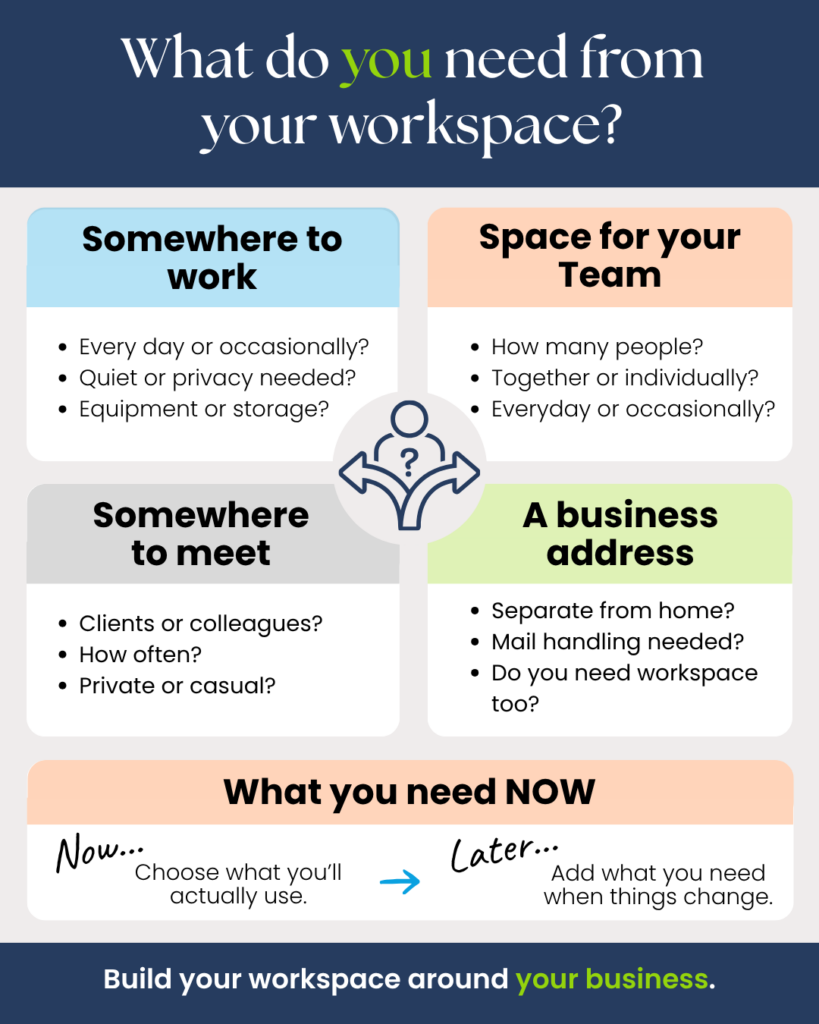
Short on time? Skip to the ‘Setting Up a Small Business Workspace’ summary graphic below.
What do you need your workspace for?
Instead of starting with “What kind of office should I have?”, think about what happens during an ordinary working week.
Where do you spend most of your time?
Do you mainly work alone, or with other people?
Do clients come to see you?
Do you need privacy for phone calls or online meetings?
Does your work require equipment or storage?
Do you need a business address that is separate from where you live?
Is your current workspace working well most of the time, with one or two things that regularly get in the way?
A person who works happily from home but meets a client once a fortnight has very different workspace requirements from a team of four who need to work together every day.
Start with what needs to happen there.
If you just need somewhere to work
Working from home can be one of the simplest and least expensive workspace options available.
If it works for you, there’s no reason to replace it because your business has reached some imaginary stage where it ought to have an office.
Your home workspace also doesn’t need to resemble the beautifully styled offices that appear when you search for home office inspiration.
It needs to let you do your work.
That might mean reliable internet, suitable equipment, somewhere reasonably comfortable to sit and enough privacy or quiet for the work you do.
Use what you already have where it works. Spend money where a limitation is genuinely causing a problem.
If working from home suits you most of the time, you may only need an alternative on the days it doesn’t. Depending on the work you’re doing, that could be a library, café, flexible workspace or somewhere else you can work for a few hours.
Occasional workspace needs can stay occasional.
If you run your business from home, business.gov.au also has a useful guide to the practical requirements and considerations involved.
If you need somewhere to meet clients
This is where it helps to separate where you work from where you meet people.
You may be able to do almost everything from home but prefer not to have clients coming there.
Think about how often you meet people and what those meetings require.
A casual conversation might suit a café. A longer appointment, confidential discussion, presentation or meeting with several people may need somewhere quieter and more private.
Hiring a meeting room when you need one gives you access to that space without paying for it every day of the month.
If this is the problem you’re trying to solve, we’ve also looked at where to meet clients when you don’t have an office and how to choose a venue based on the meeting itself.
If you need a business address
Your business address and your everyday workspace can be two separate things.
You might be completely comfortable working from home but still want a different address for the business.
In that situation, paying for physical office space just to obtain an address may be solving a much bigger problem than you have.
A Virtual Office can provide a business address without requiring you to lease physical office space, depending on what you need the address for and the requirements that apply to your business.
An address service solves an address need.
If you also need somewhere to work or meet people, treat those as separate requirements and choose the right solution for each.
If you need somewhere for a small team
Once other people need to use the workspace, the questions change.
How many people need somewhere to work?
How often will they be there?
Do they need to work together, or simply have somewhere away from home to work individually?
Do they need privacy?
Will you regularly meet clients or other visitors there?
A team that gets together once a month may only need a suitable meeting room.
Someone who needs a regular place to work independently may be better suited to a dedicated desk or similar flexible workspace.
A small team working together regularly may need a private serviced office.
And as the team grows or its requirements become more stable, leasing your own premises may eventually make more sense.
The goal isn’t to keep the workspace as small as possible.
It’s to choose the amount and type of space that fits the team.
Think about what you’re paying for
Setting up a small business workspace on a budget doesn’t mean choosing the cheapest option every time.
Sometimes the inexpensive option does the job perfectly well.
Sometimes saving money in one place creates a cost somewhere else.
Free software isn’t much of a saving if you spend hours working around its limitations.
Working from the dining table doesn’t cost you anything… in money terms. But if you’re uncomfortable, struggling to concentrate, or constantly being interrupted, it can start costing you time, focus, and perhaps a little of your sanity.
Hiring a meeting room costs more than meeting someone in a café, but privacy or fewer distractions may matter for a particular conversation.
Leasing your own premises may involve more expense and responsibility than working from home or using flexible office space, but it can still be the better choice for a business that needs the space and control.
So rather than asking:
“Which option costs the least?”
Ask:
“What am I paying for, and will I use it?”
Include the cost of your own time
Workspace costs aren’t always financial.
A cheaper option can become less attractive if it creates hours of extra administration, setup or maintenance.
Maybe you’re constantly rearranging furniture before client meetings.
Maybe you lose time travelling across town to collect mail.
Maybe you’re the person organising repairs, replacing supplies or troubleshooting every practical problem in the office.
Those tasks may still be worth doing yourself.
But the time they take belongs in the calculation.
Saving money is less useful when it quietly creates another job for you.
Let your workspace change when your business does
You don’t need a perfect three-year workspace plan before choosing what works today.
Perhaps you start at home.
Later, you begin meeting clients regularly and hire a meeting room when you need one.
Your address requirements change, so you add a Virtual Office.
You employ someone and decide you both need somewhere to work together a couple of days a week.
Eventually the team grows and a private office or premises of your own becomes the better option.
Or perhaps none of that happens and working from home continues to suit you perfectly.
A workspace can be right for one stage of the business and wrong for the next.
That doesn’t make the earlier choice a mistake.
It just means the business now needs something different.
A simple way to choose your small business workspace
Before spending money on your setup, think about five things:
Where you’ll work
Where will you do most of your work, and do you already have somewhere suitable? If you only need another workspace occasionally, you may not need to pay for one permanently.
Who needs the space
Is it just you, or does anyone else need somewhere to work? Think about how many people need space, how often they’ll use it and whether they need to work together.
What needs to happen there
Do you need somewhere for focused work, private calls, client meetings, equipment or storage? Different activities may need different spaces.
What needs to be separate
Do you need a business address separate from home? Are there conversations, documents or equipment that need privacy or security?
What you’re paying for now and later
Which parts of the workspace will you genuinely use? What do you need now, and what could you add later if the business changes?
Your answers might point to working from home, occasional meeting room hire, a Virtual Office, a dedicated desk, a serviced office, premises of your own or a combination of several options.
There doesn’t have to be one answer called “the office.”
Your workspace should fit your business
Start with the work you do, the people you need to accommodate and the practical things your workspace needs to make possible.
Use what you already have where it works.
Spend money where it makes a meaningful difference.
Add something when there’s a reason to add it.
Your workspace can grow and change with your business. It doesn’t have to arrive fully formed on day one.
Not sure what your business needs now, or what might make sense later? We’re happy to help you work it out.
With Virtual Offices, meeting room hire, dedicated desks and serviced offices in Norwest, you can start with what you need now and change your setup as your business changes.
No pressure. No need to commit to more than you need.
Setting Up a Small Business Workspace Summary Graphic
Frequently Asked Questions
What does a small business workspace need?
It depends on how you work. Start with the practical things your business needs, such as somewhere to work, a place to meet clients, a business address, privacy for calls or space for employees. You may need one of these things or several, and they don’t necessarily need to happen in the same place.
Do I need an office to run a small business?
Not necessarily. If working from home suits the work you do, there may be no reason to pay for a permanent office. You can add other options, such as meeting room hire, a Virtual Office or a dedicated desk, when there is a specific need for them.
What are the alternatives to working from home?
It depends on why working from home isn’t suitable. If you simply need somewhere else to work occasionally, a library, café or flexible workspace may be enough. If you need a regular workspace, more privacy or somewhere for a team, a dedicated desk or serviced office may be more appropriate.
How can I set up a small business workspace on a budget?
Start with what your business needs now rather than trying to create a complete office from day one. Use what you already have where it works, spend money where a limitation is genuinely causing a problem, and consider flexible or occasional options for things you don’t need every day.